

Yes and no, it all comes down to how you count. If you zoom in you can just as well argue that wind covered anything between 0 to 139 percent of the Danish demand for each hour, 1 to 104 percent per day or 9 to 78 percent per week.
Power system engineers tend to think that measuring wind power penetration by aggregated energy figures is meaningless as it is the instantaneous flows which set the system requirements. On the other hand, behind the penetration numbers a dramatic change of the power system has taken place in terms of generation portfolio, system operational rules and flexibility from load and generation.
First, here are some facts based on hourly settlement data from 2016:
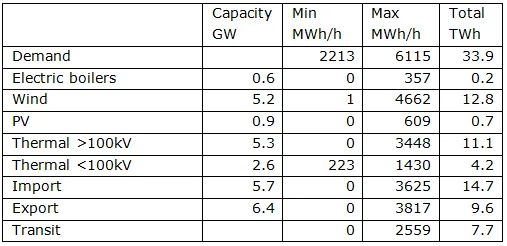
Compared to the previous year, 2016 was much less windy and although the wind capacity went up by 2 percent, the wind energy dropped by 10 percent. In contrast to Germany, photovoltaics are still playing a minor role.
Dependency on conventional power stations
In order to maintain operating voltages and sufficient short circuit power, the Danish power system has relied on the conventional power stations to remain online. This ensures stable operation of the line commutated HVDC lines, avoids trip of type 1 wind turbines during short circuit faults in high wind conditions and provides continuous voltage control.
During the last year, the system demand for must run units has been optimised considering factors such as seasonal variations in wind power (the summer period is less windy than the winter period), improved automatic shunt switching to restore voltage (to compensate the underground cables around 80 shunt reactors are now available above 100kV), and better coordination of transmission outage restoration time (cancelling ongoing outages if the system conditions change).
This effort, combined with the investment in 3 synchronous compensators and using the inherent voltage support capability of a new voltage source converter HVDC line, the system demand for forcing conventional power stations to remain online has been significantly reduced. As can be seen from the table above, we now have hours without any conventional power stations >100kV online. As an example, from the afternoon of June 25, no conventional power stations were online for 26 hours.
Energy sources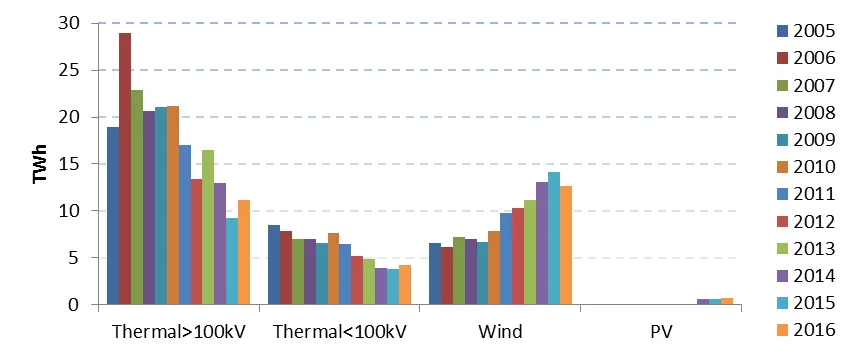
The green transition is clearly visible when looking at the annual energies supplied by thermal power and wind over the last 12 years.
The thermal power varies from year to year according to the market conditions, influenced by fuel prices and hydrological conditions in Scandinavia.
District heating systems are widely used in Denmark and this energy is typically delivered from combined heat and power generation units. Recently, 0.6 GW of electrical boilers have been installed to deliver district heating in hours where it is not favourable to operate the cogeneration units and more are on the way.
In addition, the electrical boilers are now an important service provider for down regulation as well as heat supplier when the price is very low or negative. Effectively, this has introduced flexibility on the demand side equivalent to 10 percent of the peak demand, although the conventional electricity demand remains inflexible (primarily due to the spot price only constituting ~20 percent of the end consumer energy price).
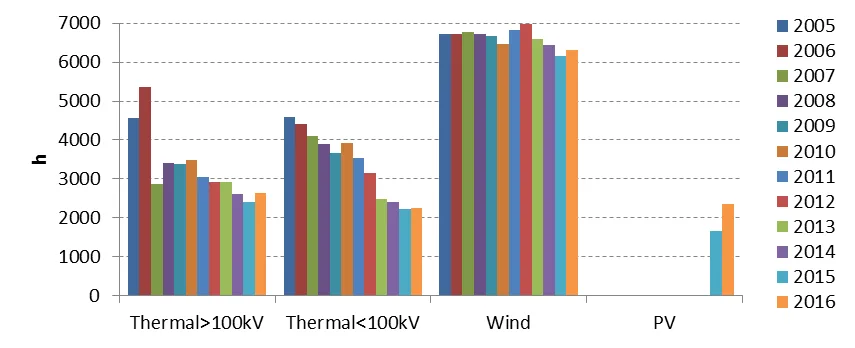
The following graph shows the average number of operating hours from the different energy sources. Despite the lower market share of conventional thermal generation, the number of operating hours is not significantly affected due to the district heating demand obligation. The embedded thermal generation <100 kV has seen a dramatic drop in number of operating hours due to the introduction of electrical boilers, boilers fueled on biomass (heat only) and the natural gas price.
Curtailment of wind power
In Germany, renewable energy has grid priority access. In case of grid congestion, the TSOs have to apply market based solutions before curtailing renewable energy. Since the German wind is generally not participating in the balancing market, while most Danish wind power is, the German TSOs are effectively purchasing down regulation from Danish wind power. If this had not occurred, the annual wind penetration would have been 0.5-1 percent higher.
In 2016 Denmark had 62 hours with negative spot prices – a large part of them driven by negative prices in Germany. Depending on the subsidy, some wind plants will shut down in such cases. An example from an offshore wind plant is shown below. The stop and restart are executed within a few minutes.
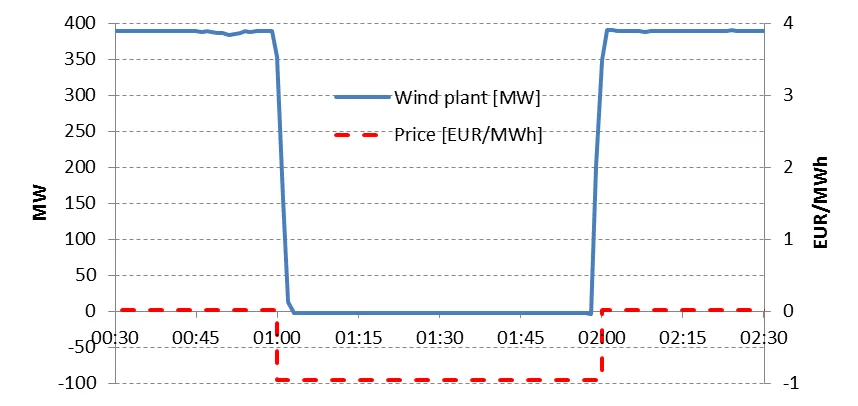
In order to assess if we can maintain proper transmission voltage in the future during such sudden changes in the power balance, some extreme scenarios have been investigated without showing significant problems. In contrast to the transmission grid, the voltage control in the distribution system is more vulnerable for such sudden change of power flows. In case of future problems, the grid code gives the TSO the right to apply a power gradient on the wind plants, but so far this is not enforced.
Outlook
Until 2020 we expect another 1.5 GW of wind power on top of the existing 5.2 GW, which will bring us beyond 50 percent annual wind energy – or however you prefer to count. Anyhow, this requires new investments in transmission as well as even more flexibility from the power system. Denmark’s goal is to be independent of fossil fuels by 2050.
Inertia? This is under observation but so far not an issue as we are interconnected to large power systems with sufficient rotating mass.
Hans Abildgaard
Chief Engineer
Energinet.dk