

“Storing Energy at Sea (StEnSea)” is a novel pumped storage concept for storing large amounts of electrical energy offshore. In contrast to well-known conventional pumped-hydro power plants, this concept greatly expands the siting possibilities, and allows for modular construction and ease of assembly. Instead of two separated water reservoirs of different heights, the StEnSea concept makes use of the static pressure of the water column in deep waters. In order to use this potential, a hollow concrete sphere is installed in deep water. A pump-turbine in the hollow sphere enables the electrical energy to be stored as mechanical energy. When the water is flowing into the sphere, the storage is generating. In this case the pump-turbine is running in turbine mode, generating electricity. In order to re-charge the storage system, the water is pumped out of the sphere against the pressure of the surrounding water column. A schematic cross-sectional view of an energy storage sphere is presented in Fig. 1.
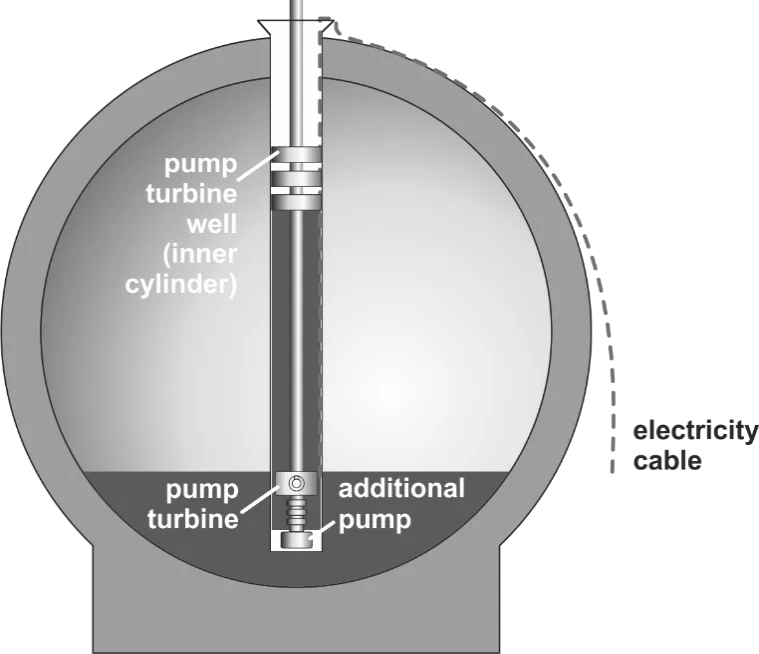
The Investigation
The concept was investigated by Fraunhofer IEE and project partners between 2014 and 2016 in Germany. A detailed system analysis was carried out including construction, manufacturing and logistics concepts of the pressure reservoir, and development and detailed design of the pump/turbine unit. In addition, grid integration on the basis of load calculations, market analyses and economic viability calculations for an international market, the development of a commercialization strategy and a roadmap for technical implementation were developed.
Phase 1
In the first phase of the project, a feasibility analysis resulted in the physical design parameters for the energy storage system. An advantage of the system is that the power and energy can be designed separately. While the power increases with the installation depth, the energy for one given installation depth can be increased by scaling up the inner volume of the sphere. The diameters depend primarily on two different design criterion. The first is that the gravitational force of the device has to be higher than the buoyancy force of the device to ensure that it stays on the seabed. The second is that the sphere must withstand the force of the pressure from the surrounding water.
There is an optimum between those two design criterions. While the pressure on the sphere increases with the installation depth, the buoyancy force is not dependent on depth. Obviously, the most straight- forward approach to maximize the power and capacity of the storage system for a given diameter is to install it as deep as possible. For the project and the first Full-Scale prototype, the diameters were the results of an optimization. Based on the fact that higher volumes lead to higher capacity, it may be assumed that it is advisable to build the spheres as large as possible, but in contrast to that, the size of the sphere has a big impact on the logistics of a project. Therefore, it has advantages to install several smaller spheres instead of one big sphere. The feasibility analysis lead to a compromise. The StEnSEA system was designed with an electrical power of 5 MW. The feasibility analysis lead to a corresponding inner diameter of 28.6 m with a wall thickness of 2.72 m, providing a volume (V_inner) of 12,000 m3. The analysis showed a commercial optimum as follows:
-
- Diameter: 29 m
- Water depth: 700 m
- Wall thickness: 2,7 m
This results in a storage capacity of about 18 MWH.
Next Step
In the 2nd phase of the project, a field test of a 1:10 scale model with a diameter of 3 m was conducted in a lake in Germany. Details regarding construction and manufacturing, installation and logistics as well as operation & maintenance of the storage system were investigated. After this successful test, a follow-up demonstration phase with a larger model (e.g. 1:3) is being planned. As soon as suitable offshore test sites have been identified and the funding is secured, the demonstration in deep water will be started.
Bernhard Ernst, Jochen Bard, Matthias Puchta, Christian Dick
Fraunhofer IEE