
G-PST/ESIG Webinar: ESIG Report on Testing the Voltage Source Behavior of Grid-Forming Resources
November 11, 2025 @ 4:00 pm – 5:00 pm

- This event has passed.
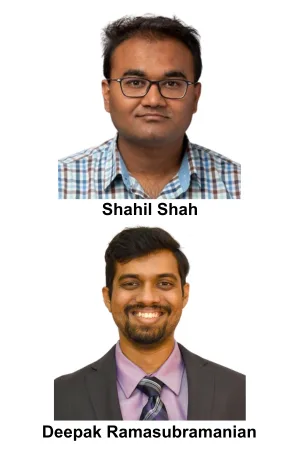
Featured Speakers: Shahil Shah, Principal Engineer, National Renewable Energy Laboratory (NREL) and Deepak Ramasubramanian, Principal Technical Leader, Electric Power Research Institute (EPRI)
About the Webinar: Grid-forming (GFM) resources are poised to play a key role in maintaining the reliability and stability of modern power systems with high levels of inverter-based resources (IBRs) and large electronic loads (LELs). Proactive deployment of GFM technologies can help mitigate reliability challenges that would otherwise require extensive transmission investments. To support their adoption, well-defined test methods and performance metrics are needed to evaluate and specify GFM behavior.
This webinar will present the findings from the newly released ESIG report, “Testing the Voltage Source Behavior of Grid-Forming Resources,” which provides comprehensive guidance for assessing the voltage source behavior of both inverter-based and rotating machine–based resources. The report introduces a structured suite of time-domain and frequency-domain tests that quantify how closely a resource behaves as an ideal voltage source with an impedance—a critical factor in enhancing grid strength and supporting bulk power system stability.
The report further defines performance metrics for each test and offers example specifications that demonstrate how voltage source behavior requirements can be applied in procurement while maintaining flexibility across GFM technologies. Finally, it links the quantified voltage source behavior of GFM resources to grid strength improvement and IBR stability margins, enabling their use in sizing GFM capacity for targeted system strength enhancement.
The webinar will provide attendees with a clear understanding of how standardized testing and performance metrics can accelerate the reliable integration of grid-forming technologies into future power systems.
About the Speakers: Shahil Shah is a Principal Engineer in the Power Systems Engineering Center at the National Renewable Energy Laboratory (NREL) in Golden, Colorado. His research focuses on the stability of power systems with high levels of inverter-based resources (IBRs) and large electronic loads (LELs), with a specific emphasis on impedance-based frequency scan methods for stability analysis and performance characterization of power electronic devices.
He led the development of the Grid Impedance Scan Tool (GIST) at NREL—an advanced platform for performing impedance-based stability analysis using both simulation models and actual hardware, including inverters and wind turbines. GIST was a finalist for the 2023 R&D 100 Awards and has been applied globally through several NREL-led collaborations. At NREL, Shahil also leads advanced testing of multi-megawatt inverters, turbines, and large power electronic loads to ensure reliable grid operation. His contributions have supported industry adoption of advanced stability analysis methods.
He holds a Ph.D. in Electrical Engineering from Rensselaer Polytechnic Institute (RPI) in Troy, New York, awarded in 2018.
Deepak Ramasubramanian is a Principal Technical Leader at the Electric Power Research Institute (EPRI) in the Transmission Operations and Planning Group.
Deepak joined EPRI in 2017 where his work is in the area of modeling, control and stability analysis of the bulk power system with focus on the impacts of large-scale integration of inverter interfaced generation and load.
Through his work at EPRI, he engages with various utilities and transmission system operators around the world to study the impact of increase in inverter-based resources in their system. Many of his projects have resulted in technology transfer to commercial simulation software and also become part of the utility planning process/guide.
In the UNIFI Consortium, he serves as an EPRI representative on the leadership team, co-leads the Modeling & Simulation area, and leads the Standards Area.
He is a recipient of a 2022 IEEE PES Chapter Outstanding Engineer Award, two Energy Systems Integration Group (ESIG) Excellence Awards, North American SynchroPhasor Initiative (NASPI) Outstanding Graduate Student Award, and the Power System Operation Corporation (POSOCO) Power System Award.
He received his Ph.D. degree in Electrical Engineering from the Arizona State University, Tempe, USA in 2017 and his M.Tech. degree in Power Systems from the Indian Institute of Technology Delhi, New Delhi, India in 2013.
Moderator: Julia Matevosyan, Associate Director and Chief Engineer, ESIG
Registration Cost: FREE
Q&A Session: We will be using the Slido platform for Q&A. Please submit your questions and follow along during the event at this link.