

In recent decades, the electric power utilities have integrated a sizeable amount of renewable energy source (RES) technologies into the power system. Their generation is inherently variable and not easy to precisely forecast in the medium term. Nonetheless, at small penetrations, the power system can still be operated more or less in a traditional manner.
However, the increasing penetration of RES is disrupting many traditional practices both in the planning and short-term operations of the power system. These RES come with high investment costs but low operating costs, in contrast with gas-fired resources, whose operating costs are higher. Planning problems include making available sufficient resources for balancing power in the short and medium term, and economic incentives to attract and retain these resources. Operational problems include the commitment of those resources to balance variability.
However, conventional pricing mechanisms may be inadequate for systems with higher levels of renewable resources.

An Unforeseen Situation
RES pricing was not foreseen in the conception of real-time electricity market pricing, designed originally for thermal resources. This conventional pricing is based on marginal pricing, the price paid to generators by the market for the power delivered. Although adequate for conventional dispatchable generation, this could prove to be inadequate for RES pricing. An initial, well-known pricing problem shows RES with low operating costs, with low bids in electricity markets driving the overall marginal price down; high-operational-cost resources would find it difficult to compete. Moreover, with this low bidding price, the RES may have difficulty recouping investment costs. In a power system with a high penetration and large swings of renewable energy, the increased net-demand variability entails a second pricing problem. In a dispatch that models generator ramping constraints, their activation will change the solution such that the retained generators will not follow the normal pricing stack, where the cheapest generators are used first.
The second pricing problem is a form of dynamic pricing. It has been the object of a few papers in the past four years in an electricity market context, and it is our understanding that it has been implemented by some independent system operators. But not much has been said of the impact of the dynamic constraints on the marginal prices over time. Here we are interested in analyzing their behavior in greater depth and illustrate the results for a simple system.
Features of the Dynamic Dispatch
Dynamic dispatch requires two changes to the static economic dispatch used to set generation levels and day-ahead prices: (i) the objective function minimizes the total generation cost over a time horizon rather than summing generation costs for separate uncoupled periods, and (ii) generator ramping constraints are modeled. In this dynamic dispatch, generation can be engaged in advance to compensate for limited ramping capability later so that the total generation cost is optimized over the entire horizon considered. Consequently, the marginal prices at any period are affected by dispatch choices made over several periods during which ramp constraints are active. The complete mathematical formulation of the dynamic dispatch can be found in this article titled “Locational Marginal Pricing in Multi-Period Power Markets.”
As a starting point in our work, we used a reasonable first approximation to model the transmission as a lossless “pipe-flow type” network, and we assumed linear cost functions.
Important Findings
The dispatch was simulated by linear programming, yielding three important results. When some generator ramping limits were activated, marginal prices at a given period:
(1) clearly exhibited temporal dependence on bids over several time periods.
(2) could be higher than the highest bid or lower than the lowest bid for any given period; they could even be negative. However, these prices were capped from below and from above.
(3) were a linear combination of bids at different periods with coefficients uniquely ± 1. This surprising result follows from the use of the pipe flow model, but it can be surmised that coefficients in a more realistic model will fall close to unity.
This type of behavior can be observed even with a low penetration of RES but is expected to be more prominent with higher penetrations.
Test Results
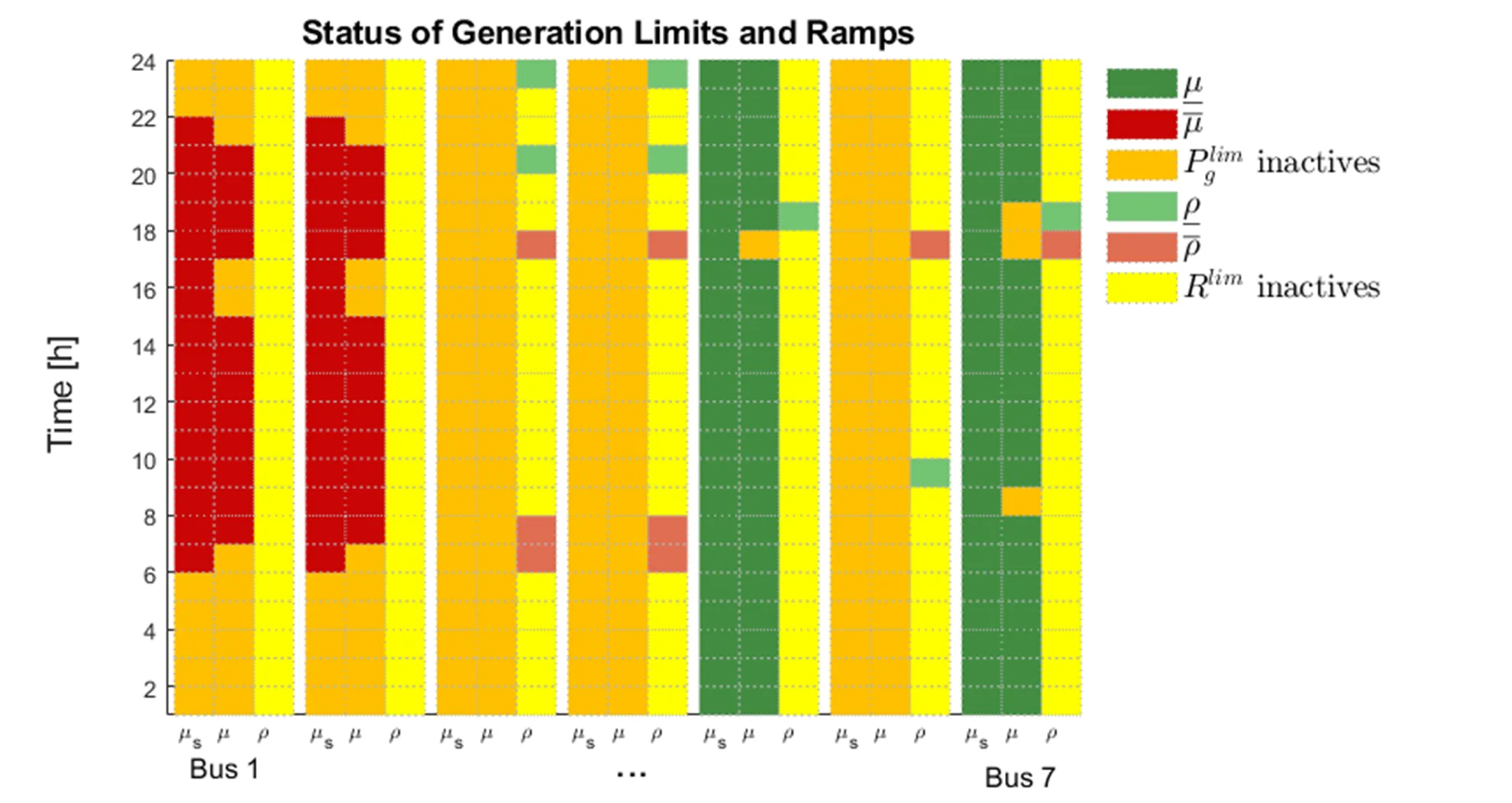
The figures below show results from a 37-bus test system, with the system parameters chosen to be realistic. The first figure shows the status of generation on certain busses in the dispatch solution as a function of time increasing on the y axis upwards. Each region has three vertical bars representing, from left to right, the generation capacity status with and without ramp constraints and the generation ramp status in the dispatch solution. The dark green or red represent periods when the generation is at its lower or upper bounds. The light green or red represent periods when the generation is ramping at its lower and upper bounds. The orange or yellow represent periods when generation constraints are inactive.
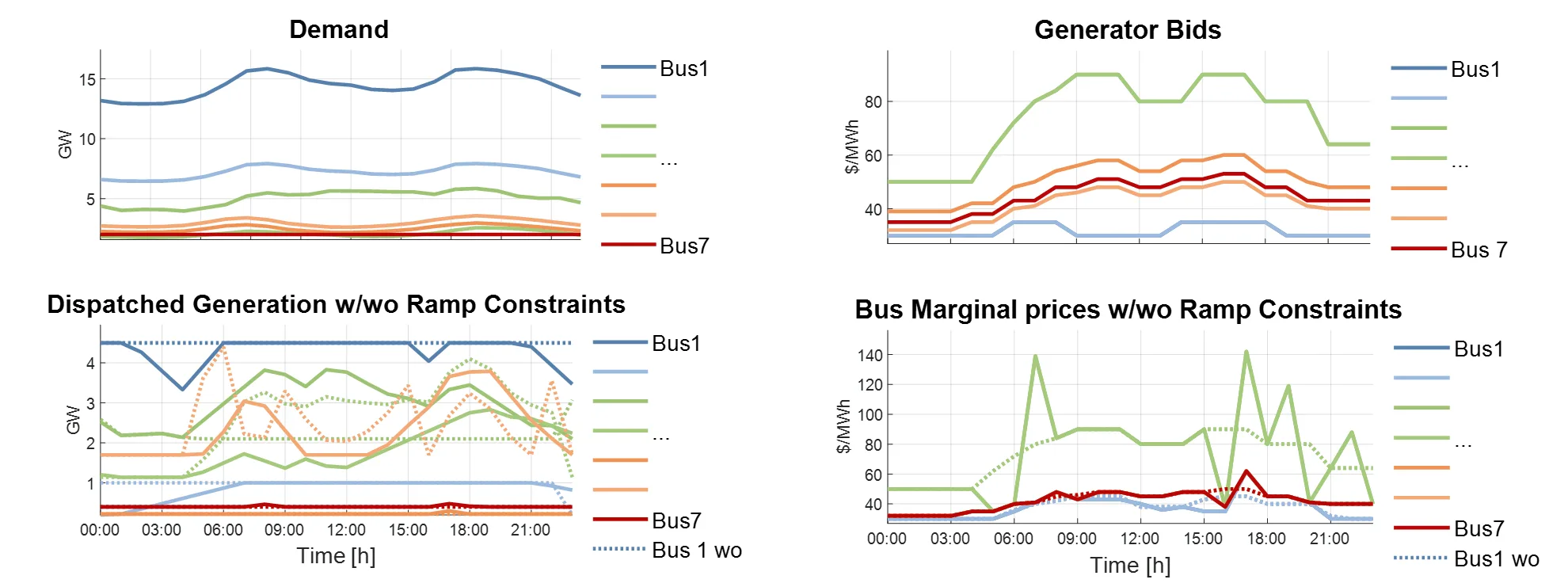
In the set of four figures below, ramp constraints were modeled (full lines) or neglected (dash lines) in the dispatch. They illustrate: (a) demand, (b) bids, (c) generation, and (d) marginal prices at several busses of the system. The figure showing generation shows differences in the dispatch with and without ramp constraints, and the figure showing bus marginal prices clearly shows the price spikes at certain busses when ramp constraints are modeled and are active. This figure shows that the marginal prices are substantially higher ($140/MWh) than the highest bids ($90/MWh) for the green bus at peak hours in the morning and the afternoon.
New Questions for Additional Research
These results open up a set of new questions:
-
- Is this behavior detected in large networks?
- Have the excessive marginal prices, analyzed here, been observed, and, if so, are they actually applied by the system operators?
- Would flexible resources be discouraged from offering their flexibility if their presence depresses marginal prices? Is this an opportunity for gaming?
In conclusion, in light of this phenomenon observed at a small scale, we should ask whether adjustments should be made to the traditional marginal pricing methodology.
Nickie Menemenlis, IREQ, Hydro-Quebec, and Maurice Huneault