
As utilities face an unprecedented wave of large load requests driven by data centers, electric vehicle fleets, and advanced manufacturing, a critical question has emerged: how will these new loads affect electricity rates for existing customers? This white paper, written by experts from The Brattle Group, helps regulators, utilities, consumer advocates, policymakers, and large electricity customers evaluate the answer.
“Impacts of Large Loads on Electricity Rates: A Primer” explains the ratemaking principles and processes that determine who pays for the costs of serving new demand, and conditions under which adding new large load customers can increase or decrease electricity rates for other customers. The paper identifies five key determinants that most often drive whether large load additions increase or decrease rates for existing customers:
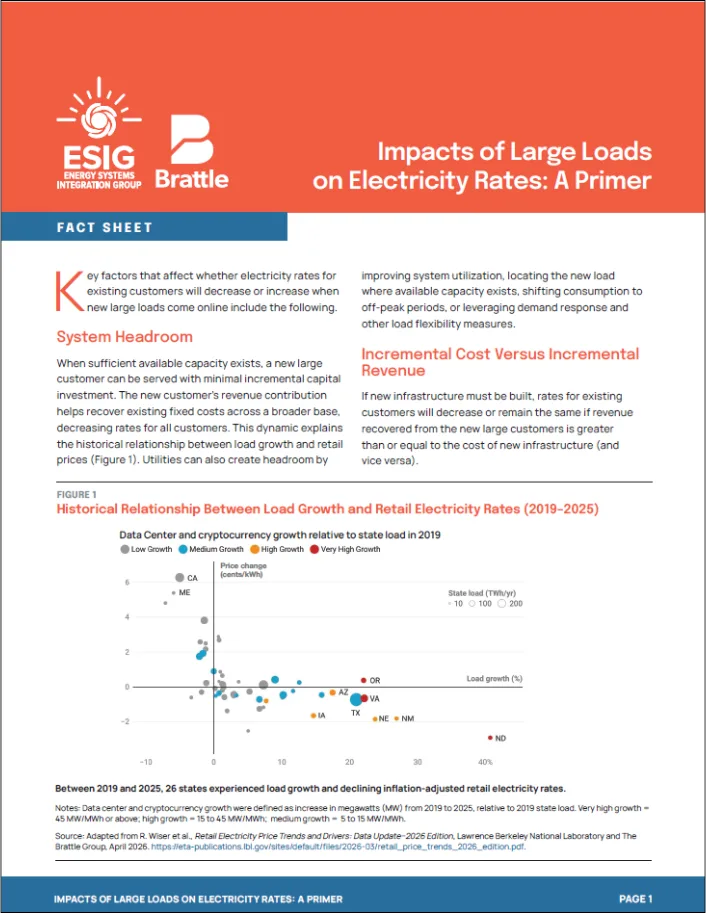
- Amount of system headroom available: When sufficient available capacity exists, a new large customer can be served with minimal incremental capital investment.
- Incremental cost of new infrastructure versus the system’s average embedded cost: Rates for existing customers fall when revenue from new large customers exceeds the incremental infrastructure cost, and rise when it does not.
- Market price exposure: New large loads can increase capacity prices in tight markets, with customers without long-term price protection bearing the impact.
- Load forecast accuracy: Existing customers may bear the cost of underused or stranded assets if expected large load growth does not materialize.
- Tariff design for large loads: Requirements such as take-or-pay, minimum bills, contribution-in-aid-of-construction, reservation charges, collateral, and exit fees can reduce cost shifts and stranded-cost risk.
The paper emphasizes that the rate impact of large loads is not predetermined in either direction. In general, if the incremental revenue collected from a new large customer exceeds the incremental cost to serve that customer, rates for existing customers tend to decrease, and vice versa. The balance depends on local system conditions, prevailing market dynamics, regulatory frameworks, and the design of tariffs, and utility contracts used to serve large customers.
The ESIG Large Load Rate Impacts Task Force is now undertaking a quantitative analysis, grounded in rate-making principles, to identify the most-impactful mechanisms to mitigate rate increases. A report will be published in summer 2026.