
UVIG might seem an odd outlet for a blog post on retail electricity pricing. But the growing disconnect between retail and wholesale prices has important implications for where we get our renewable power from in the future.
Germany’s residential customers and my son in Southern California Edison’s service territory face the same marginal retail rate – about 30 cents/kWh, while wholesale electricity prices are roughly an order of magnitude smaller (see chart). Although Germany’s available sun is more akin to Alaska than to southern California, my boy is responding the same way to that incentive as many German consumers do: by installing solar panels and taking advantage of netting provisions. These provisions allow consumers to use their midday overproduction to compensate for consumption at night and during evening and morning peaks, so that the retail rate is only charged to the net usage over a period of time. Meanwhile, both Germany and California are experiencing more frequent periods of negative wholesale prices in the middle of the day (see, e.g., the coverage in the Christmas issue of the NY Times). This means that the solar output is being forced into the system at times that it increases, not decreases, system production costs and, frequently, system pollution (see my 2015 IEEE TPWRS article on the economic and environmental cost of negative bidding by renewables).
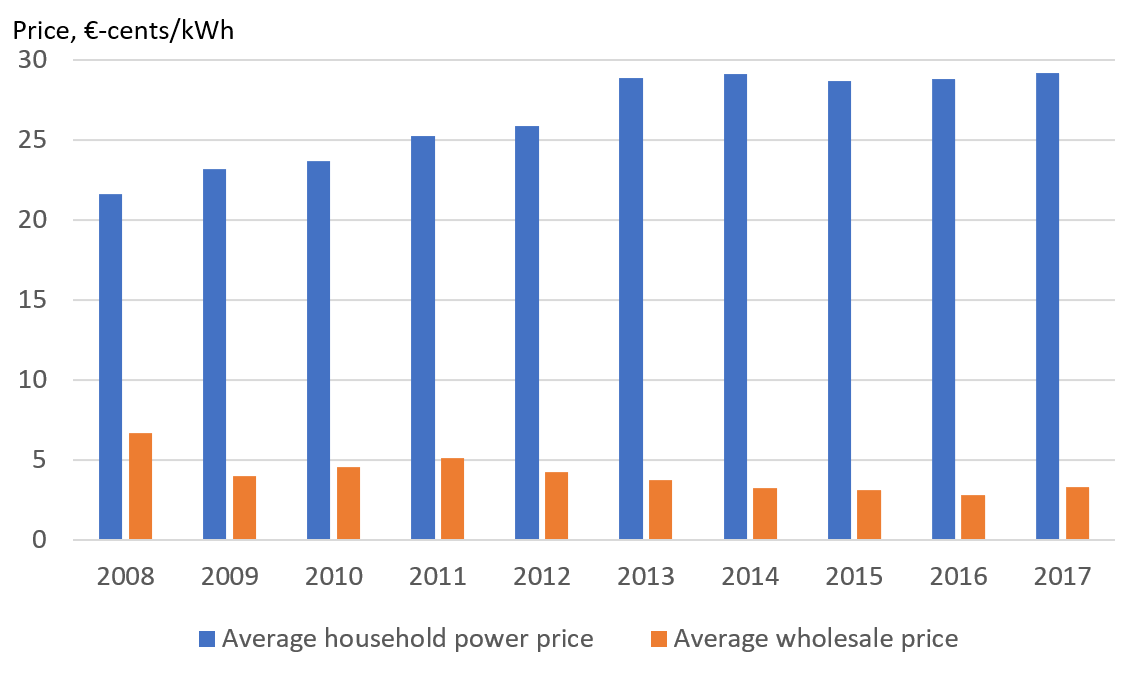
Chart: Average prices in German: household retail price (@3500 kWh/yr) and wholesale spot market prices (data sources: www.cleanenergywire.org/factsheets/what-german-households-pay-power and energy-charts.de)
What does this all have to do with wind economics? Well, the changes in retail demand have contributed to the fall in wholesale power prices (see the chart) at the same time that distribution utilities have had to raise their per-kWh network charges in order to maintain the cash flow needed to finance and operate their low voltage networks. In Germany, the network charge for household customers has gone from 5.9 Euro-cents/kWh in 2008 to 7.5 Euro-cents/kWh in 2017, while the charge for renewable subsidies has grown from 1.2 to 6.9 Euro-cents/kWh. Taxes and other fees and legacy bulk power contracts make up the rest of the difference between 2017’s 29.2 cent retail price and the 3.3 cent wholesale spot price.
The gap between wholesale and retail prices has important implications for where renewable energy investment takes place. The cost of utility-scale wind and solar is a fraction of that of roof-top solar, but this huge gap in prices encourages the latter at the expense of the former. Yes, roof-top solar can lessen resistance losses and in some cases defer distribution system investment, yet these savings are typically much smaller than the cost advantage of utility scale renewables. And yes, renewable portfolio standards in California do not count roof-top solar, so wind is not competing directly with behind-the-meter PV for those subsidies. However, in the longer term, the success of rooftop solar is likely to lessen political pressure for raising the target for utility-scale renewables. The net result will be expensive roof-top PV substituting for inexpensive grid-scale wind, and plummeting wholesale prices will increase the subsidies necessary to reach the portfolio standard.
The “law of one price” says that efficient production of a product (here, renewable energy) requires that all potential sources at a given time and place face the same price. More generally, the price received should reflect the marginal value to the market, which may differ depending on when and where the power is produced. This law is increasingly violated by the growing gap between wholesale and retail prices of power, and harms the economics of wind power. The wind industry should support retail rate reforms aimed at moving network and other fixed charges out of volumetric (per kWh) rates and into either fixed customer charges or demand-type charges. Furthermore, making retail rates responsive to real-time system conditions, rather than hiding temporal variations behind average-cost pricing and netting policies, will improve the attractiveness of bulk system wind versus behind-the-meter solar.
Although this will lower the rate-of-return my kid will get from his solar panels, it is sound economics, and he still gets to enjoy other benefits from California’s January sun while we shiver in Baltimore!
Ben Hobbs, Theodore and Kay Schad Chair of Environmental Management
The Johns Hopkins University
Chair, Market Surveillance Committee of the California Independent System Operator
Looking forward to reading more. Great forum post. Much obliged.
Law of Attraction is a Law of the Universe, as powerful as any other Law of life. In simple words, Whatever you ‘Think’ and ‘Feel’ becomes a Reality in your Life.