Over 100 years ago, DC technology lost the “war of the currents” to AC technology because its proponents failed to find a feasible way to change voltage levels. Since then, the power grid, including both transmission and distribution, has been established based on AC technology. However, the rapid growth of high-tech industry and renewable energy has once again raised interest in DC technology.

Dr. Yongning CHI
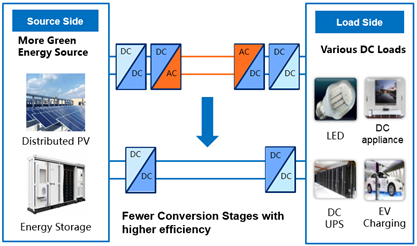
The use of DC technology in modern power systems has experienced rapid growth in recent years, and high-voltage DC (HVDC) transmission has experienced increased application globally. We are also seeing more implementation of DC technology at the distribution level, thanks to progress in electrification and digitalization. This includes the development of distributed PV with DC output and the increasing use of DC loads, such as LED lighting, electric vehicles, and data centers. The expansion of DC-based power generation units and loads brings significant opportunity for changes to the current distribution network.
Advantages of DC
Today’s power systems are under pressure to achieve increasing capacity to transport power and manage power fluctuation while at the same time ensuring reliability, power quality, and efficiency. Naturally, it then becomes a reasonable idea to explore the construction of low-voltage DC (LVDC) networks, which offer some advantages over AC:

Dr. Hongzhi LIU
1) Smaller line corridor requirement and higher power transmission capacity with the same line
2) Easier connection between distributed DC power sources and DC loads with fewer conversion stages and higher efficiency
3) Flexible topology and controllable power flow, with potential for off-grid operation
Similarly, there are advantages to building a medium-voltage DC (MVDC) network. An MVDC network has fewer nodes than an LVDC network, hence can be more easily established by retrofitting an AC network. An MVDC network helps transport more power using the existing lines to satisfy growing power consumption, and controls power flows omni-directionally among the low-voltage networks attached to it. It is also a suitable solution for offshore wind plants and industrial applications. And an MVDC network sets up the bridge between HVDC transmission and LVDC networks.
Demonstration projects for LVDC/MVDC applications have been developed by various stakeholders in countries including the United States, Italy, Germany, China, Japan, and Korea. The sizes of the projects have ranged from a nanogrid/microgrid to a local distribution network, with varied layouts and DC voltages ranging from ±110V/±375V to ±10kV.
A Need for Markets and Standardization
While academic and applied research on LVDC/MVDC networks is ongoing, the broad transition from an AC distribution system to an LVDC/MVDC network will not happen in the near future. In addition the high initial investment and not fully mature state of the technologies, the market inertia of AC and a lack of standardization for LVDC/MVDC are major factors slowing down the transition.
Standardization of LVDC networks is of critical importance since they interconnect distributed power generation units with a large variety of loads, especially household appliances that we use every day. Standardization involves many aspects, such as network topologies, voltages, operations, converter interfaces, plugs and sockets, protection, safety issues, etc. MVDC network activities are relatively less focused currently and standardization work is still lacking support; however, the International Council on Large Electric Systems (CIGRE), International Electrotechnical Commission (IEC), and Institute of Electrical and Electronics Engineers (IEEE) have all started standardization work on LVDC networks.
Waiting for the Future
The future of LVDC/MVDC networks depends heavily on market demands and economies of scale. The DC nanogrid and microgrid have been well accepted, but a widespread adoption of LVDC/MVDC networks still has a long way to go. To get there, we need to make technical breakthroughs in system protection and control, further improve efficiency and reliability of power electronic devices, and, most importantly, reach consensus on network topologies, voltage levels, and associated aspects.
Generally speaking, LVDC/MVDC networks allow for the local generation and distribution of electricity and its local consumption without transformation to and from AC with the associated loss of efficiency. However, the transition from AC to DC is challenging, and many remain skeptical about the merits of the case. Until an integral LVDC/MVDC system is developed, its full benefits over AC distribution network cannot be quantified. Until then, patience will be required.
Dr. Yongning CHI, Chief Engineer of Renewable Energy Center, China Electric Power Research Institute & Secretary, IEC SC 8A
Dr. Hongzhi LIU, Engineer of Renewable Energy Center, China Electric Power Research Institute
Leave a Reply