

We Gotta Get Out of this Place
Today we are seeing massive build out of wind and solar PV generation in places that are remote from denser population centers that constitute the lion’s share of load. Around the world, decarbonization plans will accelerate this trend. Earlier this year, Chris Clack told you about the desirable, massive overbuild of these resources. The reality is, they won’t give the benefits we need if their power is bottled up in the hinterlands.
 The problem of getting power across long AC transmission from remote areas with gigawatts of generation isn’t new to the industry. When I was a kid, the industry did “coal-by-wire,” and a quiver of technical and analytical solutions evolved to make sure the grid stayed stable. But when the power is coming from inverter-based resources (IBRs), we aren’t in Kansas anymore, Dorothy (well, maybe we are, it’s really windy).
The Nose of the Tiger
The dynamic behavior of IBRs from the instant the grid is perturbed out to a few seconds is fundamentally different. In this window of time, traditionally addressed by stability studies using phasor-based tools (like PSS/e, PSLF, TSAT…), stability is all about hanging on for the wild ride following an upset. Think: how big a pothole can you hit at what speed, and not end up in the ditch?
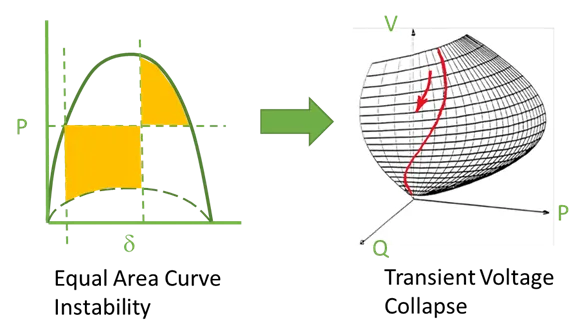 Those of us that worry about such arcana, understand that traditional transient stability limits surround the energy involved in a disturbance; specifically, we worry about dissipating the energy accumulated in synchronous machine rotors during faults. The familiar equal-area criteria gives a proxy for that entire class of behaviors. But with IBRs, the physics changes. The stability behavior of an IBR-dominant system is superior in many regards, but not all. The limits are a lot more about voltage stability than they are in a synchronous machine–dominant world. That means that we need to pay closer attention to the character of the grid — focusing on post-disturbance impedances, voltage support across the corridor, reactive regulator tuning, etc. — and less about the energy involved in the specifics of the disturbance. Consequently, fault duration is less important, and metrics like critical clearing time provide less information. Power-Voltage (PV) nose curves, and their extension to PQV solution surfaces (as shown, with the trajectory of a transient voltage collapse in red), give insight into whether the system has a safe place to land, and whether it will get there. New voltage stability metrics will need to emerge.
To be sure, not everything changes. We need to stay keenly aware of the power flows. IBRs don’t invalidate Kirchoff’s laws. The language “angular stability” somewhat displaces “rotor angle stability.” Slipping a pole is now a virtual event — the Zoom of the stability world.
 If the Band You’re in Starts Playing a Different Tune
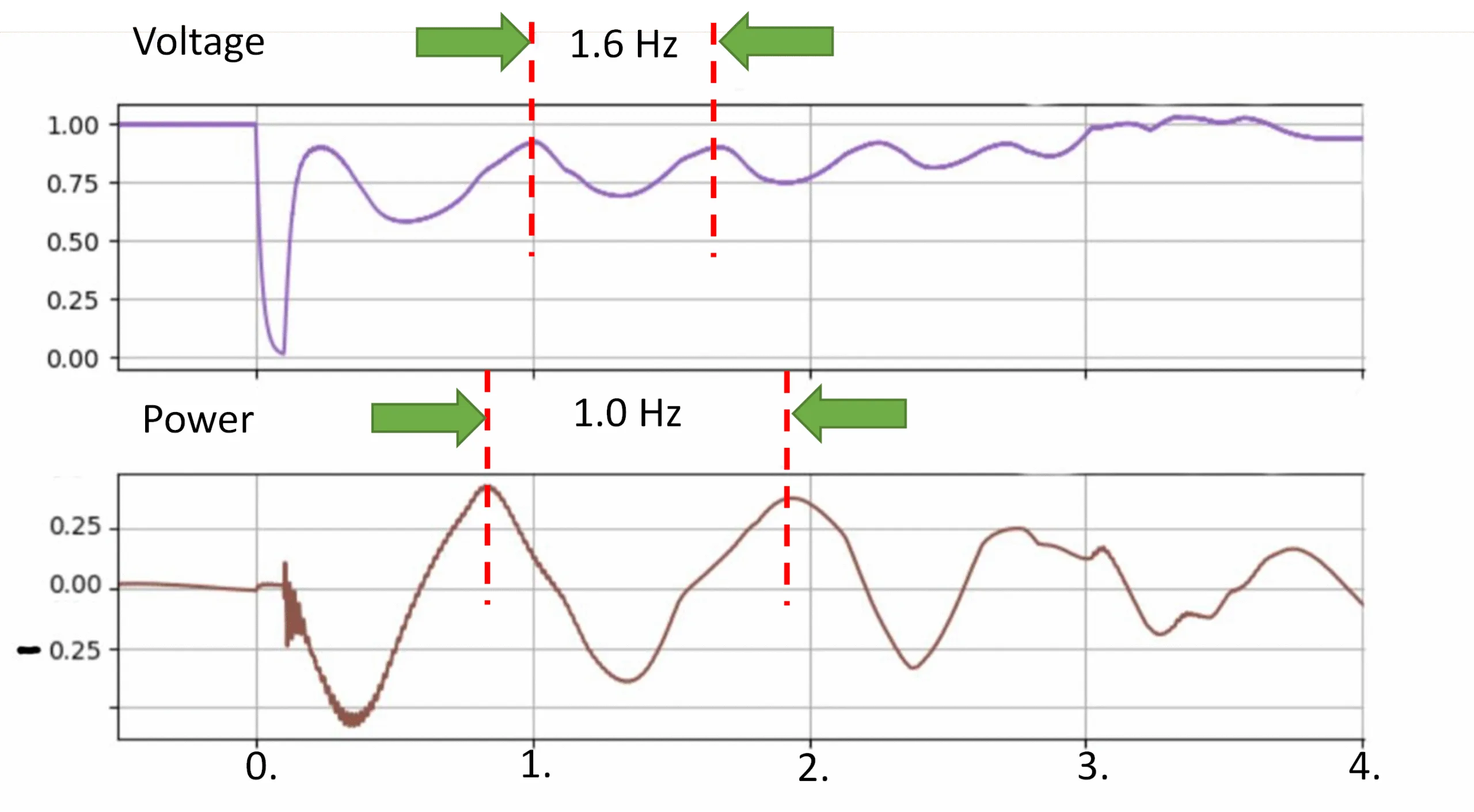
Of course, we are not charged with making a system that works just some of the time. Our systems will have mixes of synchronous and IBRs — not just generation but condensers, batteries, SVCs, etc. — that need to stay stable over ever-increasing daily and seasonal variation. That means the introduction of competing dynamics with, for example, synchronous condensers cohabiting with multiple massive wind plants. In new work sponsored by GridLab, Matt Richwine (Telos Energy) and I see the emergence of multiple, partially decoupled, stability phenomena. In this simulation, a marginally stable system with lots of IBR generation and stabilizing synchronous condensers exhibits two distinctly different phenomena. The voltage swings at about 1.6 Hz, driven primarily by the IBR regulators trying to settle to a stable equilibrium near the end of the post-fault PV nose. The power swings at about 1.0 Hz are driven primarily by the electro-mechanical oscillations of the condensers hunting for torque equilibrium. This syncopation makes understanding and mitigation more challenging. When we add grid-forming controls to the IBRs, some of this will get simpler, some not so much.
Climb Ev’ry Mountain
The industry is on a steep learning curve, but we are far from starting from scratch. The tools and understanding that are already at our disposal will take us far, as we learn better what to look for. But those tools are going to need to be augmented with new customized ones that give better insight as we shift away from electromechanically dominated stability limits. Stay tuned: this is going to be fun.
Nick Miller
HickoryLedge, LLC